
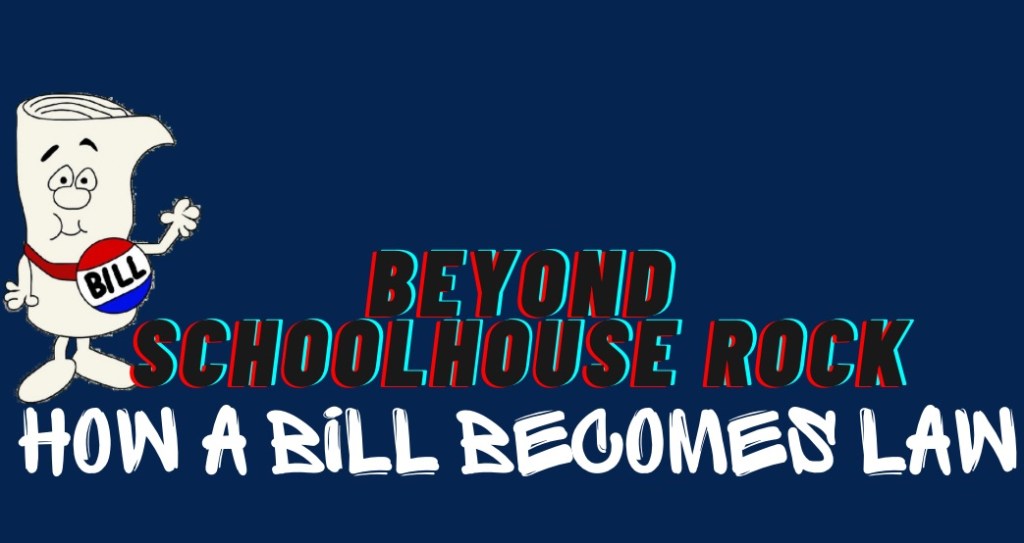
“I’m Just a Bill – Schoolhouse Rock.” Courtesy of YouTube.
“I’m just a bill, yes, I’m only a bill, and I’m sitting here on Capitol Hill…”
Across America, students young and old can recite this lovable anthem by heart. Meant to be catchy and educational, it has been screened continuously in classrooms decades after its 1976 release, with countless renditions over the ages, narrating the straight & narrow path of a bill that travels from the people of America to Capitol Hill.
But surprise, surprise: it’s not always that simple. Want to know why?
Let’s delve into what Schoolhouse Rock got right and missed the mark on. But first—how are laws made?
To dumb it down, ideas for new laws are typically introduced to Congress—a key part of the legislative branch—by a sitting Congressional member or someone campaigning to be elected as one. This means that the idea for new laws comes from existing senators and representatives, or prospective senators and representatives during their election campaigns. However, even though bills must be introduced to Congress by these current or potential Congressional members, they can begin by ordinary citizens (like us!) requesting real change in our communities by contacting our representatives on Capitol Hill.
After the idea (now called a “bill”) is proposed to Congress, the bill is assigned to a particular Congressional committee. This is a subunit of Congress that focuses on specific areas of concern for American lawmakers, ranging from taxes to foreign relationships with other countries. The committee will then research, discuss, and make changes to the bill in order to give it the best chance of passing through both chambers of Congress: the Senate and House of Representatives.
After the committee has finished its work on bringing the bill to life through added research and tweaking, the bill is then put forth to be voted on by the Congressional chamber it was proposed in first. To pass the vote, the bill only needs a simple majority, which means it would need the approval of exactly half of the chamber, plus an added vote. This equates to exactly 51 votes to pass through 100 senators, and 218 votes to pass through 435 representatives.
Once the bill passes through its first chamber, it goes through the exact same process (committees, research, tweaks, voting) in the next.
Once both chambers vote to accept the bill, they must work out any differences between the two versions of that bill that each chamber would like to see passed. This means that if the Senate and House of Representatives like the idea of the proposed law (or amendment to an existing law), but have separate tweaks to the bill, they’ll need to settle these differences between themselves.
Once they reach a version of the bill they at least somewhat agree on, the bill goes through the same voting process in both chambers—again.
If it passes both chambers, it goes on to the president, who can either sign the bill into law (hooray!) or veto it, after which it goes another round of voting in which the bill must pass with a two-thirds majority, after which it becomes law over the president’s disapproval.
Schoolhouse Statement #1: Bills Take a Long, Long Time to Become Law.
This statement is a hit-or-miss. That means that it could be true or false depending upon a few factors. These include the urgency of the bill, the timing of its introduction into Congress (Congressional sessions, election years, etc.) and the measure of agreement between different chambers of Congress and the president.
Schoolhouse Statement #2: Bills Are Sent Straight from Lawmakers to Congress.
That’s right—a bill is typically introduced by a fellow congressman, also known as the bill’s “sponsor,” to either the House of Representatives or the Senate, depending in who was contacted to introduce the bill or acted on their ideas to introduce the bill first.
Schoolhouse Statement #3: Most Bills Do Not Pass the Congressional Floor.
If the play-by-play of the different committees, chambers, and votes a bill needs to obtain to pass Congress didn’t warn you, it is notoriously difficult to pass new laws through the Congressional floors—and increasingly so in recent years.
According to political analyst Larry Jacobs, “Most bills introduced, die…you can think of Congress, and…at the state level…as a graveyard.”
Sounds ominous. But it is true: according to GovTrack.us, a database tracking the activities of Congress and the America government, there are over 7,000 bills before Congress this year. Only 7% will become law.
This has less to do with the bills themselves and more to do with the competitive special interest and lobbying groups that may oppose them. Oft-present in democratic societies, special interest groups and lobbyists refer to the people representing the causes and beliefs of a client or organization by influencing politicians and lawmakers regarding key decisions, like whether or not to pass a really important bill.
Aside from lobbyists, Congress has also become more polarized between the two-party line. This means that Democrats and Republicans are likelier than ever to vote against the bills largely supported by the opposing party, which hinders the ability of Congress to pass bills at all—after all, neither side is likely to agree with the other.
Schoolhouse Statement #4: Both the House & Senate Must Vote on the Bill to Pass It.
Absolutely—but with a twist. Tax-related legislation must originate in the House, while only the president and Senate can work to validate treaties, or agreements, with other countries, as well as laws regarding presidential nominations during national elections.
Schoolhouse Statement #5: The President Signs a Bill Into Law.
They can, but they don’t have to. If Congress is in session for the foreseeable future, the president can move to veto a bill and send it back with their objections within ten days. If they don’t act on the bill within the ten-day period, the bill automatically becomes law.
Once the bill is sent back to Congress, it is voted on once more.
If the bill passes in both chambers with a two-thirds majority, the president’s veto is overruled, and the bill is signed into law.
However, if Congress will adjourn within ten days of the bill reaching the President’s desk, the President can perform a pocket veto, which is when they do not act on the bill within those 10 days. With Congress unable to override any presidential objections, the bill never becomes law.
Any thoughts on this article, or ideas for future pieces? Comment below or DM us on Instagram @civicallysensible.us.
Sources
“Bills and Resolutions in Congress.” GovTrack.Us, GovTrack, http://www.govtrack.us/congress/bills/. Accessed 19 June 2025.
“Congressional Committees.” Stennis Center for Public Service, The Stennis Center, 24 Oct. 2024, stennis.gov/congressional-programs/congressional-committees/.
“Good Question: Why Is It so Hard to Pass a Law?” CBS News, CBS Interactive, 24 June 2016, http://www.cbsnews.com/minnesota/news/good-question-passing-bills/. “How Laws Are Made.”
USA Gov, USA Gov, 5 Nov. 2024, http://www.usa.gov/how-laws-are-made.
Rock, Schoolhouse. “I’m Just a Bill – Schoolhouse Rock.” YouTube, Schoolhouse Rock, 18 Aug. 2014, youtu.be/SZ8psP4S6BQ?si=1h5G7UJfBWblTrMn.
Stuessy, Meghan M. “Regular Vetoes and Pocket Vetoes: In Brief.” Congress.Gov, Library of Congress, 18 July 2019, http://www.congress.gov/crs-product/RS22188. Villet, Reagan. “Latest Vanderbilt Unity Index Shows the U.S. Continuing Its Trend toward Increased Political Polarization.”
Vanderbilt University, Vanderbilt University, 14 Feb. 2024, news.vanderbilt.edu/2024/02/14/latest-vanderbilt-unity-index-shows-the-u-s-continuing-its-trend-toward-increased-political-polarization/.
 Civic Sense
Leave a comment