

It all started on a scorching summer afternoon last week. I was stuck indoors for the day because it was so hot you could fry eggs on the pavement. With nowhere to go out and nothing to do inside, I turned back to my computer to write.
However, I had a severe case of writer’s block, so I did what any totally serious civic blogger would do. I played video games.
ROBLOX is a free-to-join, online gaming platform with millions of users and thousands of games that throw players into alternate realities where they can shop, explore, battle, or even simulate systems and events inspired by real life. Obviously, as one of my favorite games growing up, I decided to give it another go.
That’s when I found a game called Oath of Office by Chesapeake Studios. It was this minigame in which players simulated the United States government and political stage.
Let’s just say it was…very interesting.
In the game, you got to choose whether you wanted to serve in the Executive, Legislative, or Judicial branch—for $4.99. If you decided to pay for it, great! You could snag a job being a Cabinet secretary, Congressperson, and even the President. If you didn’t, you were basically a political candidate of the Independent Party that got to witness the chaos unfold.
I joined the server in the middle of a MASSIVE election, with piping hot tea spilling from both parties. President Hector Mendoza of the Freedom Party was competing against candidates Luke Miller and Harper Moore of the Visionary Party. Moore and Miller, incumbents from a previous presidential administration, doubled down on Mendoza’s inaction on several key issues, from immigration to the economy. Their campaign slogan was “Unlike Mendoza, we’ve done this before.” I thought it was weirdly ironic, because Mendoza was literally finishing up his own term in office, but it was really catchy, which made their eventual win that night a surprise to no one. Their landslide victory was met with jumps and cheers from tens of viewers for the new administration.
Once the election wrapped up, the server teleported all players to the Inauguration ceremony, where there was lots of chatter about their joys and resentments from the recent election—including a handful of players who wasted no time in surrounding the president with job requests.
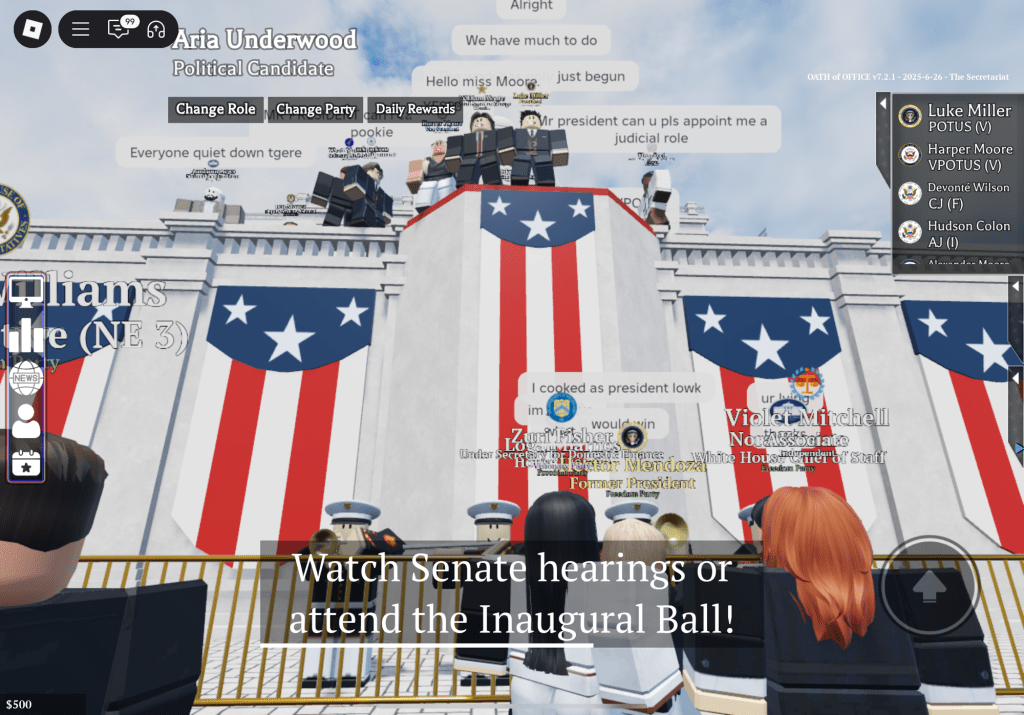
The ceremony, unlike those in real life, was surprisingly swift. The new President and Vice President recited a simple oath given to them by the Chief Justice in the game chat.
After the ceremony closed, I stood outside of the Oval Office, watching congratulations being given and drama beginning to spiral. Within the span of thirty minutes, there were siege threats, a scandalous firing of the Homeland Security advisor, new presidential bids for the NEXT election, and treason accusations. It was hilariously dramatic and shockingly intense, which made it so much fun.
The next game I played was called “Courtroom Shenanigans” by creator rayraydog. The game worked by appointing various players as the judge, bailiff, prosecution, defense, and jury of different cases in each round. Each case was centered around an accusation, which ranged from stealing flowers to being sent into Squid Game. The judge presided over the case, sitting in a high chair at the front of the courtroom. The prosecution and defense consisted of players advocating for themselves in their cases, and they made some pretty convincing arguments. After an accusation landed that a player ate someone’s family, they even whipped out a grenade to prove their innocence.
Talk about commitment.
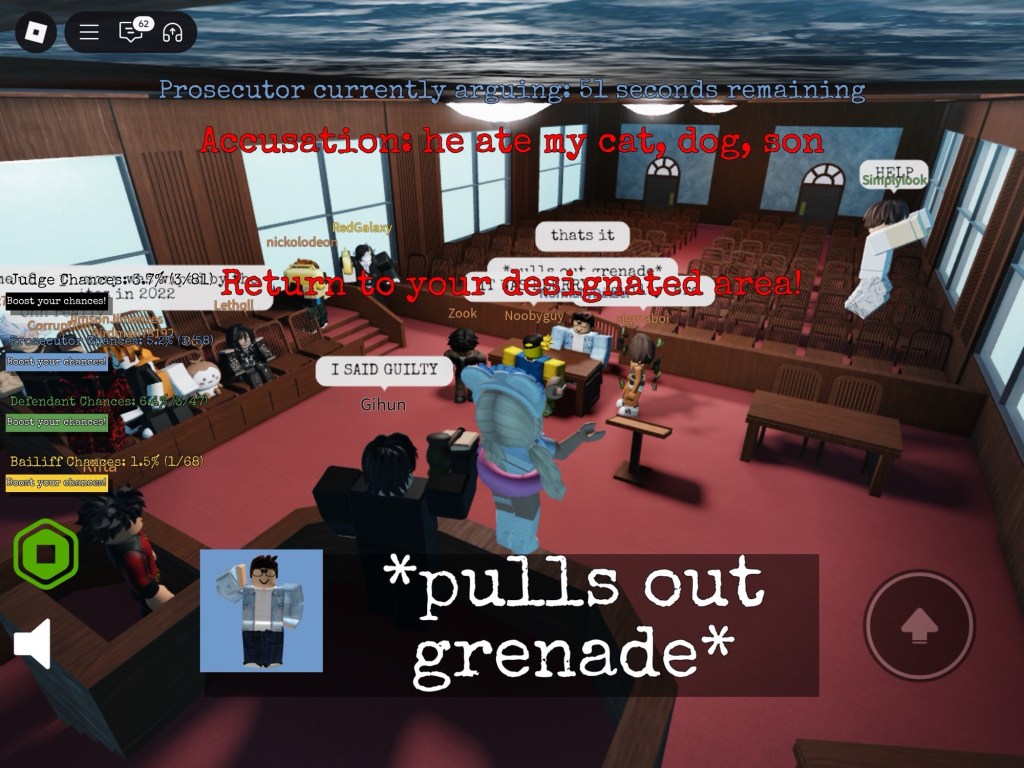
The whole game was an incredibly funny and fresh take on courtroom dramas, with cool roles to experience and some striking similarities to real cases, including the presence of a full jury who votes on each verdict and passionate stories from players trying to prove (or disprove) one’s innocence.
But if nonsensical courtroom chaos doesn’t appeal to you, try the game “Up for Debate” by rayraydog, where players dish their hot takes on some of life’s biggest questions—like whether or not bad driving is an attitude problem, or if young people should be embarrassed about their lack of basic repair skills. Players would be randomly assigned to either “agree” or “disagree” with the questions.
Let’s just say it was a wild ride hearing them come up with answers in an effort to “win” the debate.
Debating is an incredibly important process in civics and democracy through which people analyze different perspectives, learn to construct arguments supporting causes they believe in, and engage in respectful dialogue. Simulating these debates online in a safe, enjoyable environment is incredibly important towards promoting civic engagement, especially within fellow young people!
But if you want to scrap the campaign chaos and courtroom anarchy altogether, give “work as a loan officer” by Yingjie100 a try. As the player, you have just graduated from university with lots of debt, and have taken up a job as a loan officer at a local bank for a living. On your first day at work, your boss comes up to you with a game tutorial (designed as a list of rules to follow) and a stern warning not to mess up. Or else…
One by one, “clients” filed up in front of my desk to ask for money for their vacations, jobs, businesses, tuition, and more. As the player, I had to search each of their names on the in-game computer in front of me to find out more about them, including their credit score and criminal record, in order to decide whether to actually give them a loan. For such a simple game, it was really fun to help chart people’s ambitions like that.
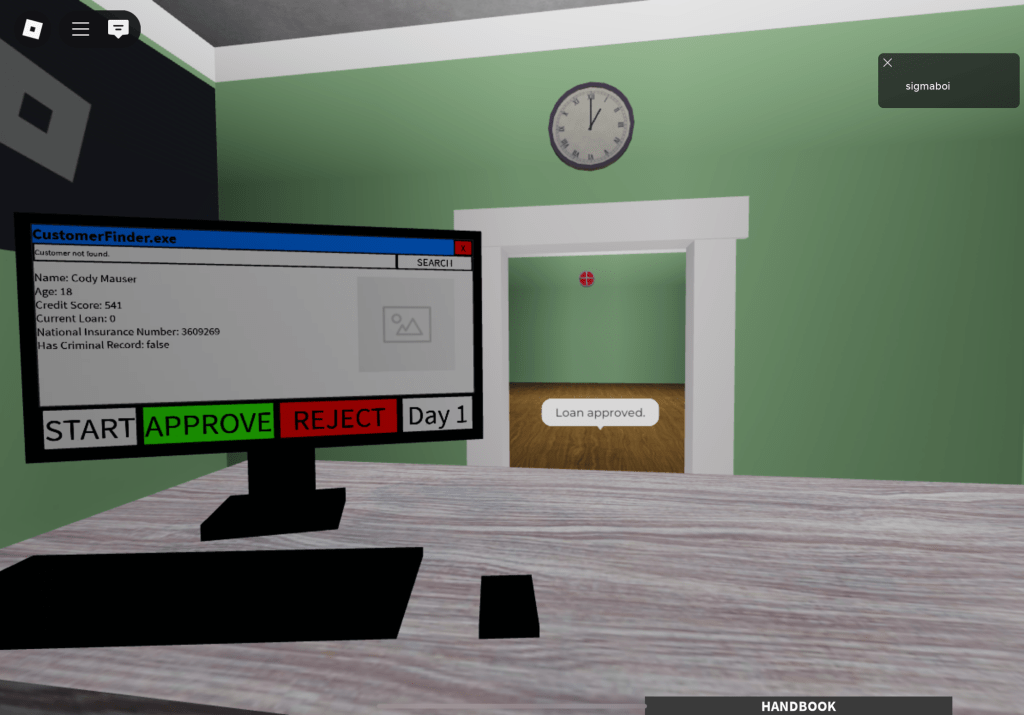
Loan officers are often underlooked and serve very important roles in modern civics. They provide loan options and assess the eligibility of people and businesses applying for loans, much like my “clients” in the game. These officers quietly power financial systems by helping people access the money that helps build their futures.
Who knew civic literacy and democratic processes could come from the most chaotic corners of the internet? Whether you’re defending your innocence in court with a grenade or deciding someone’s financial future as a pixelated loan officer, games like these show how some of our society’s most important systems work for young people everywhere.
 Civic Sense
Leave a comment